28 August 2008

Film | O Brother, Where Art Thou?

2000 | 106min | Colour | USA Crime-Adventure-Comedy

Homer's epic poem "The Odyssey", set in the deep south during the 1930's. In it, three escaped convicts search for hidden treasure while a relentless lawman pursues them.
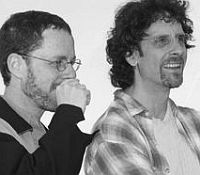


  DIRECTORS  
Joel and Ethan Coen

  SCREENWRITERS  
Joel and Ethan Coen
Homer (poem The Odyssey)

  CAST  
George Clooney, John Turturro, Tim Blake Nelson, John Goodman, Holly Hunter, Chris Thomas King, Charles Durning, Del Peentecost, Michael Badalucco, J. R. Horne, Brian Reddy, Wayne Duvall, Ed Gale, Ray McKinnon, Danial von Bargen

  OSCAR NOMINATION  
Ethan Coen, Joel Coen (sceenplay), Roger Deakins (photography)

  CANNES FILM FESTIVAL  
Joel Coen nomination (Golden Palm)

  FIRST IMPRESSIONS  
A folksy, screwball, picaresque comedy. A wild romp in the deep south, like Prozac to the great depression. It's the bombastic result of crossing Three Stooges with the Greek poet Homer. The film is surprisingly light for the Coen Brothers, closer to the farcical Hudsucker Proxy rather than the heavy Miller's Crossing and Fargo.

The three men shuffle down the dusty road.

PETE
The hell it ain't square one! Ain't
no one gonna pick up three filthy
unshaved hitchhikers, and one of 'em
a know-it-all that can't keep his
trap shut!

EVERETT
Pete, the personal rancor reflected
in that remark I don't intend to
dignify with comment, but I would
like to address your general attitude
of hopeless negativism. Consider the
lilies a the goddamn field, or-hell!-
take a look at Delmar here as your
paradigm a hope.

DELMAR
Yeah, look at me.

George Clooney plays a wonderfully exaggerated, over-articulate and vain ex-convict called Ulysses Everett McGill. Being Clooney he's somehow likable and naturally enchanting, even with his toothy grin. Plus the twerps he travels with are completely lovable rather than annoying as I at first expected them to be. They're warm-hearted and thoughtful in their simplicity, especially the cretinous Delmar (Tim Blake Nelson), my favourite. Even with their gaping mouths and lost eyes, they are completely essential to the film's depth.

"Sing in me O Muse...”, the line at the beginning of the film, is the first line of the Odyssey.

The Coen Brothers' interpretation of "The Odyssey" is inventive, outlandish, and risky because of the story's core jaggedness and difficulty to shape into a whole. Lots of action and fast-cuts, the movie progresses quickly as a collection of whimsical and high-stake situations. Although the plot feels slightly spasmodic, it's saved by the dialogue and hilarious characters and oddities. Quite simply, it's clever, clever writing. I've included a lot of quotes along with some shots below. I also love the constant mythological and historical parallels.

Director of photography Roger Deakins' sun-baked, dirty-ochre cinematography is impeccable. A similar sparseness was created in No Country for Old Men. I love the contrast of the dry land with the deep blue sky.

And of course the film was greatly enriched by its extraordinary bluegrass soundtrack and would be nothing without it -- entertainment and atmosphere plus plus. Overall, downright bona fide.


  TRIVIA  
  • Was one of the first major features to use digital answer printing, where the entire original film print was scanned into digital format, manipulated, and then reprinted on film stock. This changed the colour design, as the directors and cinematographer Roger Deakins wanted to create a dustbowl effect to convey depression-era 1930s South, with sepia and brown tones. It's possible to compare the original footage with the outcome by looking at the trailer, produced before digital manipulation.
  • The title is taken from the title of the film the director wants to make in Preston Sturges' Sullivan's Travels (1941).
  • Although Homer is given a co-writing credit on the film, the Coen Brothers claim never to have read The Odyssey and are familiar with it only through cultural osmosis and film adaptations. I find this hard to believe given the depth of their adaptation.
Below I have included more information on the adaptation, sceen shots and quotes.


See more...
  ADAPTATION  
The names of George Clooney and Holly Hunter's characters are Ulysses and Penelope. The Latin equivalent of the Greek name Odysseus is Ulysses.

They catch a ride on a hand-pumped railway that is being operated by a blind prophet, who tells them that they will not find the treasure they seek. The prophet character in the Odyssey was Teiresias, whom Odysseus consulted in the underworld when he needed information on how to get home again.

In the Odyssey, Ulysses angers the god Poseidon with pride, and is thus sent on his journey. His travels come to an end when he shows humility. Everett similarly scoffs at the baptisms of Pete and Delmar, and soon finds many obstacles in his path homeward. His trek also ends when he humbles himself. Not ironically, water is involved at both points - the baptisms and the flooding - since Poseidon was the god of the waters. Near the end, Odysseus nearly drowned, but clings to a piece of wood. At the end, Everett's line, "Finding one little ring, in the middle of all that water, is one hell of a heroic task," is a reference to the legend of Theseus, who had to find a golden ring at the bottom of the ocean to prove he was the son of Poseidon.

Most obviously there were the three girls by the river as the Sirens. Also, one-eyed Big Dan as the Cyclops (blinded with a burning pole), and Ulysses' wife marrying someone else when he comes home. Further, the changing of one of Ulysses' companions into an animal, and killing of the cattle of Helios by the "fools" in the Odyssey is mirrored by Baby Face Nelson shooting the cows.

The movie theatre scene is like the trip through the Underworld and the Baptists are like the Lotus-eaters.


Every time Ulysses falls asleep something bad happens, just like Everett always has to wake with a start. The song which plays throughout the movie is called "Man of Constant Sorrow", Odysseus means "man who is in constant pain and sorrow".

The Ku Klux Klan has a rank of Grand (or Exalted) Cyclops. Much like the KKK scene, Odysseus and his men hide from the Cyclops by dressing as sheep. Also, Odysseus and Everett both reveal themselves by performing an act no one else could: Odysseus strings a special bow and fires it through seven rings; Everett sings "Man of Constant Sorrow" as only the leader of the Soggy Bottom Boys can.

EVERETT
Say, uh, any a you boys smithies?
Or, if not smithies per se, were you
otherwise trained in the metallurgic
arts before straitened circumstances
forced you into a life of aimlesswanderin'?


DELMAR
You work for the railroad, grandpa?

OLD MAN
I work for no man.

PETE
Got a name, do ya?

OLD MAN
I have no name.

EVERETT
Well, that right there may be why
you've had difficulty finding gainful
employment. Ya see, in the mart of
competitive commerce, the-

CHILD
You men from the bank?


BOY
Come on, boys! I'm gonna R-U-N-N-O-F-T!

DELMAR
You should be in bed, little fella.


DELMAR
Well that's it boys, I been redeemed!
The preacher warshed away all my
sins and transgressions. It's the
straight-and-narrow from here on out
and heaven everlasting's my reward!

Reference | The character of Tommy Johnson is based on famed blues guitarist of the same name who, according to folk legend, sold his soul to the Devil at the crossroads in exchange for his prodigious talent. Robert Johnson, another bluesman and a contemporary of Tommy's (but no relation), borrowed the legend and wrote a song about it (and so the soul-selling legend was subsequently, wrongly, attributed to Robert Johnson).
TOMMY
I had to be at that crossroads las'
midnight to sell mah soul to the
devil.

EVERETT
Well ain't it a small world,
spiritually speakin'! Pete and Delmar
just been baptized and saved! I guess
I'm the only one here who remains
unaffiliated!

EVERETT
What'd the devil give you for your
soul, Tommy?

TOMMY
He taught me to play this guitar
real good.

Delmar is horrified:

DELMAR
Oh, son! For that you traded your
everlastin' soul?!

Tommy shrugs.

TOMMY
I wudden usin' it.

PETE
I always wondered-what's the devil
look like?

EVERETT
Well, of course there's all manner
of lesser imps'n demons, Pete, but
the Great Satan hisself is red and
scaly with a bifurcated tail and
carries a hayfork.


EVERETT
What're you gonna do with your share
of the treasure, Pete?

PETE
Go out west somewhere, open a fine
restaurant. I'm gonna be the maider
dee. Greet all the swells, go to
work ever' day in a bowtie and tuxedo,
an' all the staff'll all say Yassir
and Nawsir and in a Jiffy Pete...

He gives his coffee a thoughtful swish and murmurs:

PETE
An' all my meals for free...

EVERETT
What about you, Delmar? What're you
wonna do with your share a that dough?

DELMAR
Visit those foreclosin' sonofaguns
down at the Indianola Savings and
Loan and slap that cash down on the
barrelhead and buy back the family
farm. Hell, you ain't no kind of man
if you ain't got land.

Symbolism | Sheriff Cooley, who fits Tommy Johnson's earlier description of the Devil exactly: "He's white, as white as you folks, with empty eyes and a big hollow voice. He likes to travel around with a mean old hound." Fantastic symbolism in this shot.


Shots | Camera shakes beautifully in the car scene.
DELMAR
Friend, some of your folding money
has come unstowed.

NELSON
HA-HA! COME ON YOU MISERABLE SALARIED
SONSABITCHES! COME AND GET ME!

George Nelson, cackling wildly, fires into the air
as his car recedes.

Acting | George Clooney plays such a vain charmer - even as he enters into a bank to rob it, he carefully places his cap on his head and smiles at onlookers for a millisecond of the farce. What a
performance!

Reference | The historical Baby Face Nelson was a gangster named Lester M. Gillis (a.k.a. George Nelson, "Big George" Nelson, Lester Giles, Alex Gillis, etc.) who was known for his hot temper and itchy trigger finger. He was killed in Barrington, Illinois, in November of 1934 - three years before the setting of the film.

Casting | Look at the casting of the old lady who mumbles at George Nelson. Priceless!

MAN
Oh mercy, yes. You gotta beat that
competition.

Makes me laugh every time.


Sound | Effectively changes voice emphasis when shot focuses on different singers

DELMAR
Caintcha see it Everett! Them sigh-
reens did this to Pete! They loved
him up an' turned him into a horney-
toad!

Reference | When Ulysses first meets Big Dan in the restaurant there is a statue of Homer in the background.


Cutting | Often uses diagonal, circles, or very slow disolve.

DELMAR
We thought you was a toad!

Reference | The scene where Ulysses, Pete and Delmar come upon the KKK meeting is a reference to the scene in The Wizard of Oz (1939) when the Tin Man, Scarecrow and Lion sneak up on the Witch's castle. The chanting and formation marching of the Witch's guards are mimicked by the KKK members. Infiltration is achieved in both films by overpowering three guards and KKK members respectively and donning their garb.


EVERETT
I'm the only damn daddy you got! I'm
the damn paterfamilias!

OLDEST
Yeah, but you ain't bona fide!

The Anatagonist | Not a big fan of Sheriff Cooley. Sure, he provided an occasional overarching enemy that we knew the protagonist would eventually face, but he was far too ambiguous. However, this might just be a reaction to the character, rather than a criticism of the film.

Crane shot | As Everett drops to his knees to pray, the camera adopts a high-angle position above him then pulls back and upward, as if his appeal to the almighty has taken flight.

  REFERENCES  

01 June 2008

24-hour couture


{source: US Harper's Bazaar June 2007}

14 April 2008

30 March 2008

01 January 2008

Where are the city guides?

Well, not here.  They are coming.  I'm completely over-the-top in documenting favourite spots when travelling, but several moleskin travel books have disappeared.

Coming up: Amsterdam Andorra de la Vella Barcelona Belgrade Berlin Budapest Brisbane Carcassonne Copenhagen Dublin Dubrovnik Fez Florence Hong Kong Hvar Istanbul Ljubljana Lisbon London Madrid Marrakech Milan Oslo Paris Porto Prague Riga Rome Roskilde Singapore Sydney Tallinn Tirana Toulouse Vaduz Valencia Valetta Venice Vienna Vilnius

08 September 2007

Style stalking Lauren Davis


{click it}

Here's an article on Lauren's 30th birthday in New York from US Vogue May 2006...

17 August 2007

07 August 2007

Drifting Along with the Jetty Set


It all began at Ljubljana, capital of Slovenia, which I am proud to say I can finally pronounce.

Q. But where on earth is Slovenia?
A. In the alps next to Italy, south of Austria, on the Adriatic Sea.

I stayed at my friend Ana's place in the centre of the old city, a stones throw from the slender River Ljubjanica. It was great to hear her distinctive Slavic accent again. Her house was so inviting, some stone walls dated back to the 13th century when the Romans occupied the area, local elderly women tended the back garden that we were free to raid for fresh vegetables, and downstairs was a Bosnian restaurant with the best Turkish coffee in town – sadly discovering it on my last day, noooo.

While Ana was at work for a mere 4 hours each day, I ignored the savage summer heat and walked around the city past animated pavement cafes, their tables spilling out onto courtyards and down the cobbled streets. It was like being at the crossroads of Vienna and Venice, filled with beautiful buildings – a harmonious mix of Baroque and art nouveau architecture. The famous Slovenian architect Joze Plecnik left a lasting mark on the city, as he also did in Vienna and Prague, designing many of the city's beautiful bridges, buildings and squares.

After work Ana would take me out to see some of the lesser known sights, and to meet with her gang of friends at various bistros. The Slovenians definitely like to have fun, and go out and party (well, the fraction that I saw were out every night). And unlike most cities that are crowded with foreigners at that time of year, I really felt like one of the few outsiders, a great feeling, I hate being just another Australian. Ana was hilarious in her introductions, it seemed that everyone we met or she pointed out was a mild celebrity, whether they were a TV presenter, actor, national football couch, eurovision performer, or politician. With a national population of only 2 million people, everyone was someone. In the early hours of the morning we'd walk home in the crisp night air, Ljubljana Castle towering over us, dramatically lit beside the city centre.

One day, a car full of us drove up to the freshwater lakes to the north of Slovenia. There we exhausted ourselves by swimming around the lake, hiked up to a magnificent waterfall, and later sunbaked while I read Harry Potter (oh my, I ended up in the Slovenia newspaper because I lined up for the book at midnight, might I add that was two hours after sunset).


{Find moi!}

Craving a peek at the Adriatic sea, three Slovenian friends and me drove across to the gorgeous Venetianesque gem called Piran with its peeling plaster facades and a dramatic campanile. It's located on the 46.5 km of coastline belonging to Slovenia. Look left and you can see Croatia, look right and there's Italy. Poor Slovenia – after the early 90s conflict, Croatia emerged with a lion's share of the Adriatic coastline (have a look at a map and you'll see what I mean). Piran has an unspoilt medieval structure that we loved to wander around, eventually stumbling across the creamy marble Tartini Square where we ate the local favourite of prosciutto pizza and drank red wine near the waterfront passeg iatta. And oh! the sunset views over olive groves and red roofs! Terribly sad that I only spent a day there.


{Piran, Slovenia}

It was interesting to meet with so many local people and try to grasp even a fragment of their amazingly complex culture. According to the locals, the Slovenians have been influenced by the Italians and their dolce vita lifestyle, but are also strongly influenced by German and Austrians in the north, giving them a strong work ethic. I didn't really notice this too much, but I'll take them at their word! This region has always been controlled other rulers, be it the Austrians, Italians, Napoleon or Tito, but I quickly learnt that the Slovenes are quite stubborn and self-confident, and have always managed to save their own language and identity. It's obvious that their literature helped them achieve this, as Slovenes prize their authors, poets and polymaths more than any European country I've seen yet. Ljubljana is festooned with busts of novelists and playwrights, rather than mere politicians or generals.

Next stop, Hvar. Oh Hvar, my beloved Hvar. How I do love thee, let me count the ways… This place was a PARADISE island, on the Dalmatian coast, Croatia. Hvar town is a car-free haven of Venetian architecture set right on the crystal blue waters of the harbour. Date palms line the marble-paved streets and main piazza. The moment I stepped off the ferry I had a sensory overload of beautiful boys and a vast flotilla of gigantic, shiny yachts, bam! bam! bam!


{On water taxi to Palenki islands}


{Welcome to Hvar}

Twice we took a taxi boat over to the Palenki islands, idyllic and secluded, clothing strictly optional. We hired sunbeds and umbrellas, naively frolicked with "jalebes" and avoided the "mosquitos" *wink*, and spent hours just reading and basking in the sun half naked. Apparently we met some famous DJ that I didn't know, but we went snorkelling together, avoiding the fish that liked to nibble on your feet. Later I got bored after finishing my second book, so swam half way around Jerolim island for the fun of it, stopping only to talk to people on a passing speedboat who ferried me back into shore!

By then I had worked up enough of a tan to walk into a bar without everyone staring at the amazing albino women. "Carpe Diem" was my favourite, albeit mildly pretentious and desperately hard to get into without my local friends, but it had the best atmosphere and music, the craziest crowds and the best cocktails. It was a fresh concoction of young, relaxed travellers just craving fun.


{Speela and me in Carpe Diem}

At this time of the year on Hvar "mosquitos" were to be avoided at all costs, the desperately hopeful Italian boys that pounced on you the moment you glance at them (accidentally) telling you that you are the most glorious creature they've ever set eyes on (even though you know you look like rubbish as you're in the middle of making dinner and have darted out of the apartment to buy olive oil!). On the other hand, "Jalebes" or in English "seagulls" are the local Croatian boys that have a reputation for soaring from girl to girl.

We spent many days on Hvar itself, where families crowded onto narrow pebble beaches and strips of rock. The water was divine and crystal clear. My friend Zvezdra and I took voyeurism to a new level as I borrowed her binoculars and watched people in the distance, entertained by daring young Croatians as they made graceful dives and astounding leaps from the Jetty. Blaring beach parties were scattered along the shores of the island, and we often dropped by them as we walked home from a day of tanning, inhaling the smell of lavender as we went.

After a week it was time to commence my journey back to Copenhagen. I returned to Split again for the day, the main port to the Dalmatian islands. With the help of a vibrant young Croatian called Luka that I met in a hotel lobby, I got to know Croatia's second largest city. I loved its Mediterranean feel, and especially the gorgeously lived in Diocletian's Palace, which conjures up the bygone grandeur of Ancient Rome. Luka told me that the palace was built as a retirement home for a Roman emperor, and pointed out a breathtaking hotchpotch of architectural styles, including Roman, medieval and Renaissance. And I could live on the Croatian ice cream, ledo scoops could cure cancer. Communication wasn't a real problem as most people spoke English, except for once when I finally resorted to performing a locomotive "choo choo" to get to the train station, the taxi driver laughed at me the whole way there.


{Split, Croatia}


{Statue of Bishop Grgur Ninski, in Split - touching the statue's big toe is supposed to bring good luck!}

So that was that, I then made my way back to Copenhagen to my family there. What a brilliant trip! So much extra detail has been skipped in this blog, but I can't write all day and I dare not bore you with more frivolities. Overall, if I reflect openly on the whole trip, what hit me the most was limitless opportunities in life, and the importance of choosing thoughtfully and give weight to the power of chance. Haha, oh yes, that did sound cheesy, but these messages popped up time and time again. I really look forward to returning someday, hopefully soon.

27 July 2007

Never Netherland

Let's begin, how long was I there? Um, 2 + 2 + 3, therefore a week (I'm loosing track of time), but wow, what a week it was! It began with my train journey from Copenhagen to the Netherlands, fell asleep, and woke up on a ship. No kidding. The whole train actually goes on ferry across to Germany but I was oblivious to this until I got off and went upstairs to find myself on the top deck of this enormous ship, with duty free shopping and bars, in the middle of the Baltic Sea. Bizarre!

After 10 hours on the train, foolishly only bringing a book on physics and 'strange loops' that I thought I might like, I arrived at the historic city of Arnhem on the river Rhine. I stayed in a friend's apartment which turned out to be a 3 storey share house/art den, paint and plants everywhere, reggae music pumping. I suppose I spent most of my time talking to housemates, also they showed me around their very green but unusually quiet city, and rode around for a bit trying out their new longboard (fell off, naturally).


{Playing chess in Arnhem}

Next stop: Nijmegen, a small town towards the south of the Netherlands, to visit my old housemate Jonne. I happened to be there during their famous summerfestival, one of the biggest in Holland. Nijmegen is considered to be the oldest city in the Netherlands, and is renowned for its beautiful village-like qualities – it's a slice of Dutch life without tourists wandering around in joggers and bum bags. By day middle aged people sporting socks and sandals emerged to take part in "Vierdaagse", an annual four day walk, 50km per day, the real reason behind the week-long festival. However, when the sun goes down the movers and shakers from all over Holland descend on outdoor discos set up around the city as some of the best DJs in Europe entertain music-hungry crowds. The streets were littered with Heineken beer stalls and live performances, and music roared into the apartment from all directions. Jonne was a great host: we also drove around the countryside, visited her horse and I rode around the city on the back of her bike – side saddle, that's how the Dutch do it! – to go to restaurants and parties.

Next to ol' Amsterdam, to visit cousins and further explore the city that combines metropolitan verve with a small-town spirit. I spent a lot of time walking along the narrow brick-paved streets in the city centre and Jordaan (my favourite district), framed by a skyline of pretty 17th and 18th century gables, past window boxes bursting with blooms. But I think that the city was best seen at night with the fairy-lit bridges and large-windowed canal houses that looked like lanterns strung along the waterside.

It was great to catch up with family, eating Indonesian (a previous Dutch colony) in de 9 Straatjes, with the occasional black Miss Marple bicycle rattling past. The Anne Frank museum blew my mind, and I was enlightened at the Van Gogh museum – previously I thought he was too faddish, was really limited of me. I loved seeing the flower markets on Spui again, and discovered its cafes favoured by local journalists and the literary set. All around there were constant reminders of the Dutch quirky humour on nouveau-Roman monuments and shop names, and especially from my cousin Pieter.

Even today it's just about having an easy lifestyle. But I once read that that's the problem with Amsterdam, you get so taken up with the ease of the place that you forget why you came. Amsterdam doesn't have the same effortless sophistication of Paris, but why should I even try to compare the two? Amsterdam is the hub of the alternative and social experimentation, littered with the flotsam left by new wave British, American and Antipodean residents during past eras: hippies paradise in the 60s and 70s, gay capital in the 80s, and party haven in the 90s. And today? Who knows?


{Jonne and her horse}


{Amsterdam canal}


{Best blackberries ever, like caviar!}

I have more photos but can't show them due to camera mood swings, but hopefully I'll fix it up when I return to Denmark.

03 July 2007

Paris, je t'aime

{Jessica and I at Musée Jacquemart André}

LISE BOUVIER
Maybe Paris has a way of making people forget.

JERRY MULLIGAN
Paris? No. Not this city. It's too real and too beautiful to ever let you forget anything.

- An American in Paris, 1951


Well, a week has passed since I first arrived in Paris, land of legendary art, cigar smoke, and crispy bagettes; staying in an apartment with mum and Jess. I don't care what people say, Paris is my favourite European city – there is no substitute.

The last few days were spent meandering through several Paris neighbourhoods: the Marais, the Rue du Faubourg St.-Honoré, the Palais Royale, rue Saint-Michel. It's so funny because everything here is such a beautiful cliché, you feel like you're walking around a French film set.

We visited the restored Museé de l'Orangerie to see the Monet waterlilies in their original home, and yesterday enjoyed baguettes with brie on the not-so-sunny lawns in Jardin du Luxemborg, but, mostly, we've shopped as if we were engaged in a kind of sociological study of French customs and style. We have rendezvoused with family friends in the 6e and visited the Sorbonne with them, and discovered some fantastic new restaurants in the 1em. Mum and Jess were looking for Napoleonic era antiques, which gave me time to explore some of the markets (discovering a human skeleton and a stuffed two headed sheep, eek!). Each day has ended with complete exhaustion, and it was nice to simply gaze across the seine from Pont Neuf as the sun sets around 10pm.

{Fontaine de Medicis, designed in 1624, in the Jardin du Luxembourg}


{Confections at Gerard Mulot}


{Mama}


{I went to this flower shop when wandering around the 5e, specializes in bouquets that are organized by scent rather than by colour.}

{Antiques and taxidermy at the Clignancourt markets}


{at the Sobonne}

{Jessica at Hotel Costes}

The most alluring thing about Paris isn't just its incredible elegance and die hard fashion, ladurée macaroons, or even the never ending history and customs that ooze out of the wide 19th century boulevards and crooked medieval lanes. I think, contrary to whatever others may think, that Paris is so authentic, that's why I love it here. Intelligence is revered, independence is respected and passion is considered essential. Like most great cities it reveals itself with a myriad of surprises, but in an atmosphere that makes you feel like what you're doing is substantial. Day after day the city unfurls itself, exposing even more prodigious possibilities in life than any other place I've been to yet.

Today was my last full day here, perhaps I'll come back in a few weeks, unless I'm seduced by some other city in my travels. Traditionally France seems okay with infidelity so it will just have to live without me for a while. Haha, man I am so lame. I've been here one week and all of the sudden I think I'm Oscar Wilde exciled to Pari!

{a perfect dinner}